 Weaving (Tejido)
Threads of Time: The Ancient Art of Andean Weaving on Backstrap and Pedal Looms
A Tradition Older Than the Inca Empire
Long before the Inca built Machu Picchu, Andean hands were already weaving. The oldest textiles recovered in Peru date back more than 6,000 years, unearthed at Huaca Prieta in the La Libertad region — fragments of cotton and plant fiber that prove weaving is not simply a craft here, but a civilization-defining act. The tool at the center of that history is the telar de cintura, or backstrap loom: a deceptively simple device that anchors to the weaver's body at one end and a fixed post at the other, transforming human tension and movement into cloth.
Today, that same loom is still in active use across Peru — in the highland communities of Cusco and Puno, in the northern villages of Incahuasi and Cañaris in Lambayeque, and deep in the Amazon among the Asháninka people. What appears unchanged is, in fact, a living practice: continuously adapted, community-held, and passed through generations of women who learn to read and write in thread before they learn the alphabet.
Taquile Island: Where Weaving Is a Language
Nowhere is this more strikingly documented than on Taquile Island, a small community floating in Lake Titicaca at 3,800 meters above sea level. In 2008, UNESCO inscribed Taquile's textile art on its Representative List of the Intangible Cultural Heritage of Humanity (inscription #00166), recognizing a tradition in which cloth communicates identity, marital status, community role, and cosmological belief. Men on Taquile knit while walking. Women weave complex chumpis (belts) using backstrap looms, encoding meaning into every geometric motif. The community collectively owns the designs — no single artisan claims authorship, because the knowledge belongs to everyone.
The Pedal Loom: Colonial Encounter, Andean Mastery
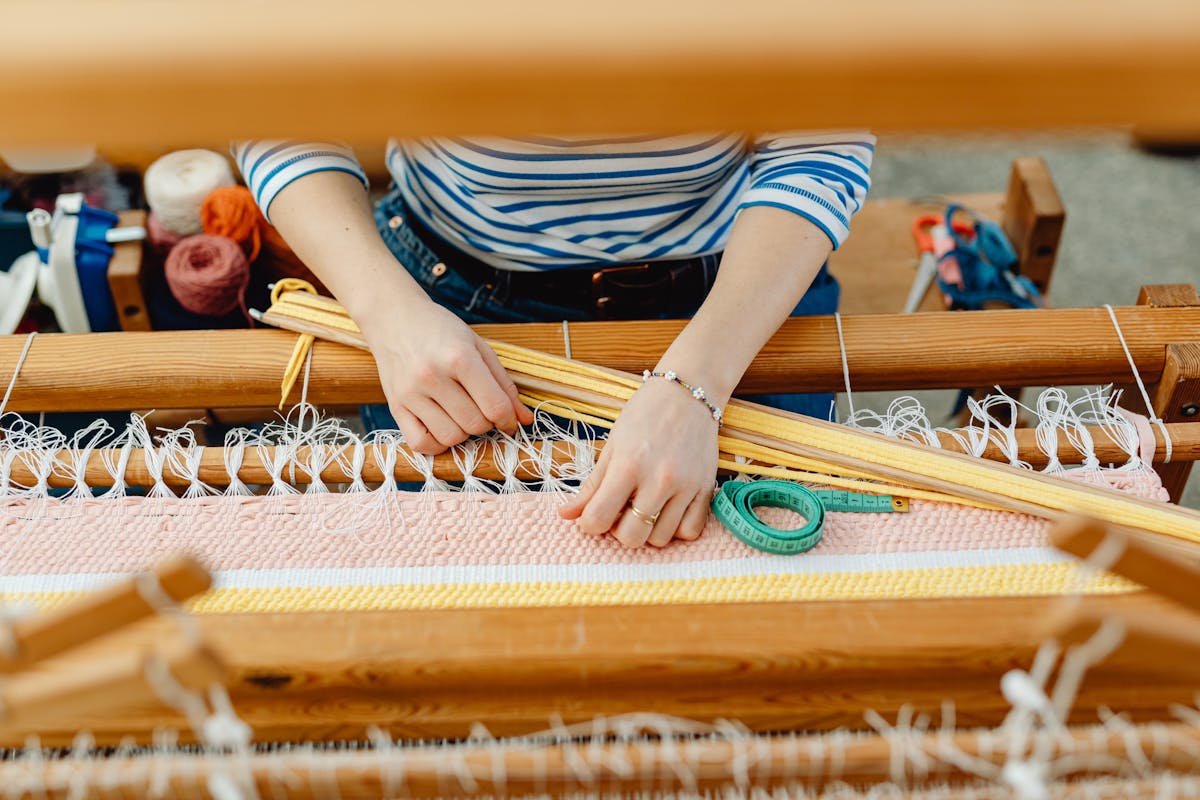
The Spanish introduced the pedal loom — the telar de pedal — in the 16th century, and Andean weavers absorbed it into their repertoire without abandoning the backstrap. Where the backstrap loom excels at fine, narrow ceremonial textiles and allows intimate control over complex patterns, the pedal loom enables wider cloth and higher production volume, making it well-suited for blankets, shawls, and table runners. In highland workshops today, both looms often coexist in the same room, each chosen deliberately for what the piece demands.
Innovation Rooted in Respect
Peru's government has recognized that sustaining this heritage requires both cultural respect and economic infrastructure. Under the Instituto Tecnológico de la Producción (ITP), three CITEtextil Camélidos centers — located in Puno, Cusco, and Arequipa — provide artisans with technical training, quality certification, and access to markets, without displacing traditional methods. These centers sit at the intersection of ancestral knowledge and modern commerce, helping weavers meet international standards while preserving the hand processes that make each piece irreplaceable.
The raw material underpinning all of this is alpaca fiber — and Peru holds an extraordinary global position. According to MIDAGRI (Peru's Ministry of Agrarian Development and Irrigation), Peru is home to approximately 4.3 million alpacas, representing roughly 80% of the world's total population. The majority graze in the high-altitude puna grasslands of Puno and Cusco — the same regions where weaving traditions run deepest. Fiber, loom, and community form a single, inseparable system.
What You Hold When You Hold One of These Pieces
Every alpaca textile at Alpaca Culture is the outcome of this long chain: an animal raised at altitude, fiber shorn and sorted by hand, dyed with natural pigments or carefully selected synthetics, and then woven — often on the same style of loom used before written history began in the Americas. The irregularities you might notice are not imperfections. They are the signature of a human body at work, a reminder that no machine made this, and no algorithm chose the pattern.
These are not souvenirs. They are documents of one of the world's great weaving civilizations, still very much alive.