 Applications (Aplicaciones)
Arpilleras: A Borrowed Tradition, Reimagined in Peruvian Hands
A Tradition Born in Resistance
To understand a Peruvian arpillera, you must first travel to Chile. In the 1960s, the folk artist and ethnomusicologist Violeta Parra began popularizing a textile technique on the coast of Isla Negra: small, vivid scenes stitched onto burlap, using scraps of fabric to document everyday rural and working-class life. The word arpillera simply means "burlap" in Spanish, but what Parra helped ignite was far more than a craft — it was a visual language for communities without a platform.
After the military coup of September 1973, that language became urgently political. Under Augusto Pinochet's dictatorship, women organized through the Vicaria de la Solidaridad — a Catholic human rights office in Santiago — to stitch arpilleras documenting disappearances, hunger, and state violence. The pieces were sewn in secret and smuggled abroad, serving as testimony when spoken words were too dangerous. From 1973 to 1990, these textile panels functioned as both archive and act of defiance.
How the Technique Traveled to Peru
Around 1979, Chilean volunteers brought the arpillera technique across the border to Lima, teaching it to women in Pamplona Alta, a pueblos jóvenes settlement in the district of San Juan de Miraflores. These were communities of recent migrants — families who had left the Andes and the provinces in search of work, carrying their memories of highland festivals, agricultural cycles, and communal rituals with them into the crowded hillsides of the capital.
What happened next is a textbook example of cultural exchange done right: Peruvian artisans did not simply replicate the Chilean model. They transformed it. Rather than scenes of political persecution, Peruvian arpilleras began depicting the textures of their own lived experience — religious processions winding through Andean villages, the shared tables of comedores populares (community soup kitchens), market days in Cusco and Ayacucho, and the bittersweet geography of provincial memory viewed from urban exile.
Textile Applications: A Recognized Artisanal Line
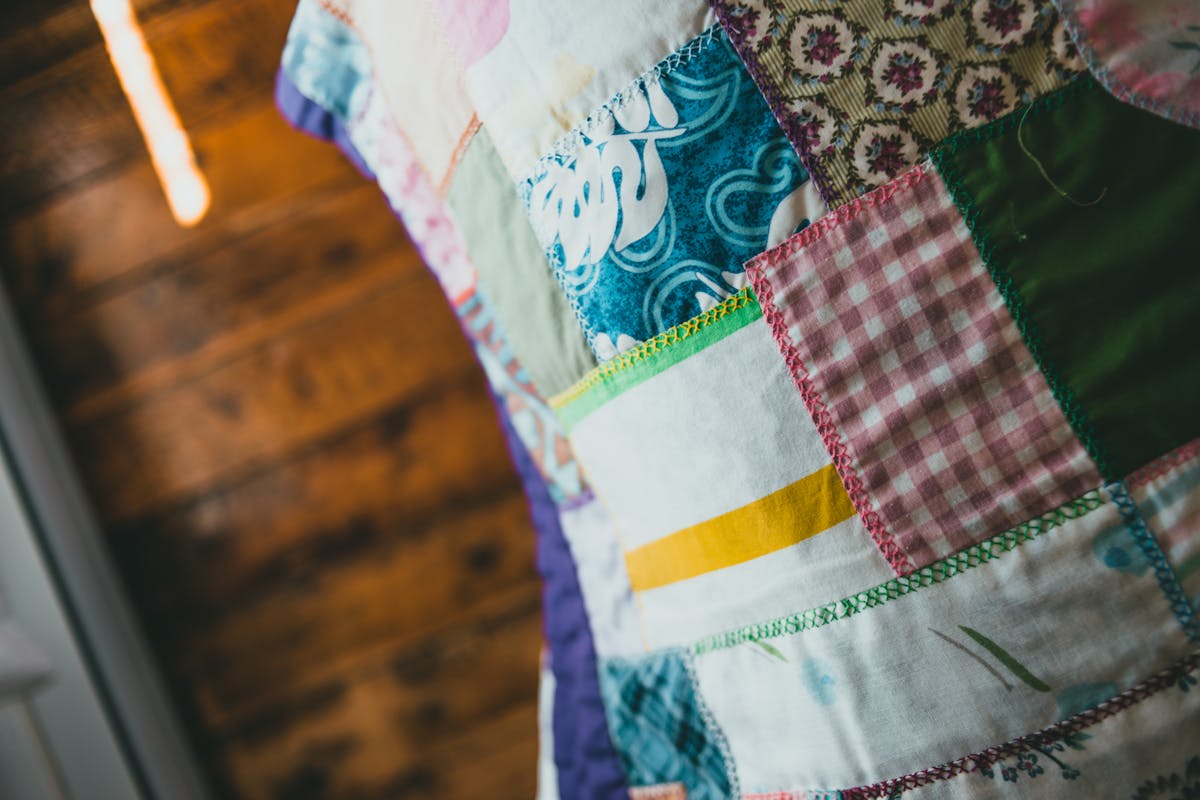
Today, the arpillera technique is most widely expressed through what artisans and trade bodies call textile applications — pieces in which cut fabric shapes are layered, appliquéd, and hand-stitched onto a textile backing to build three-dimensional narrative scenes. According to MINCETUR (Peru's Ministry of Foreign Trade and Tourism), textile applications are an officially recognized artisanal production line under Peru's national craft classification system, acknowledging their cultural and economic significance to artisan communities across the country.
The materials themselves tell a secondary story. Andean artisans frequently incorporate offcuts of alpaca wool, remnants of hand-dyed weavings, and recycled cloth — a practice rooted in both necessity and a deeply Andean ethic of nada se pierde (nothing is wasted). The result is a textile that is layered in every sense: materially, historically, and emotionally.
What Makes a Peruvian Arpillera Distinct
Where Chilean arpilleras were primarily documentary and political, Peruvian examples tend toward the celebratory and mnemonic. They are acts of remembering — preserving the colors of a hometown market, the silhouette of a mountain, the pattern of a grandmother's manta. For the women of Pamplona Alta who first learned the technique, and for the generations of artisans who followed, the work is simultaneously personal archive and community portrait.
For US buyers — whether museum gift shops seeking authentic craft narratives, boutique hotels curating culturally resonant interiors, or individual collectors — a textile application is not decorative in the passive sense. It is a document. Each piece encodes a specific geography, a specific memory, a specific set of hands.
Alpaca Culture and the Arpillera Tradition
At Alpaca Culture, we source textile applications directly from artisan cooperatives whose work traces a clear lineage to the Pamplona Alta workshops of the late 1970s. Knowing the origin story — Chilean in seed, Peruvian in full bloom — only deepens the value of what these pieces represent. We believe that honest provenance is part of what you are buying.